
How The Internet Works
Internet
The Internet (or internet) is the global system of interconnected computer networks that uses the Internet protocol suite (TCP/IP) to communicate between networks and devices. It is a network of networks that consists of private, public, academic, business, and government networks of local to global scope, linked by a broad array of electronic, wireless, and optical networking technologies. The Internet carries a vast range of information resources and services, such as the inter-linked hypertext documents and applications of the World Wide Web (WWW), electronic mail, telephony, and file sharing.
The origins of the Internet date back to the development of packet switching and research commissioned by the United States Department of Defense in the 1960s to enable time-sharing of computers. The primary precursor network, the ARPANET, initially served as a backbone for interconnection of regional academic and military networks in the 1970s.
Types of Connections
- Dial-Up
- Broadband
- DSL
- Cable
- Fiber optic (FIOS)
- Wireless(WiFi)
- Mobile
- 3G
- 4G
- 5G
Internet Equipment
- Modem
- Router
- Switch
- Firewall
- Cable
- NIC
- Access Point
- Repeater
Internet Architecture
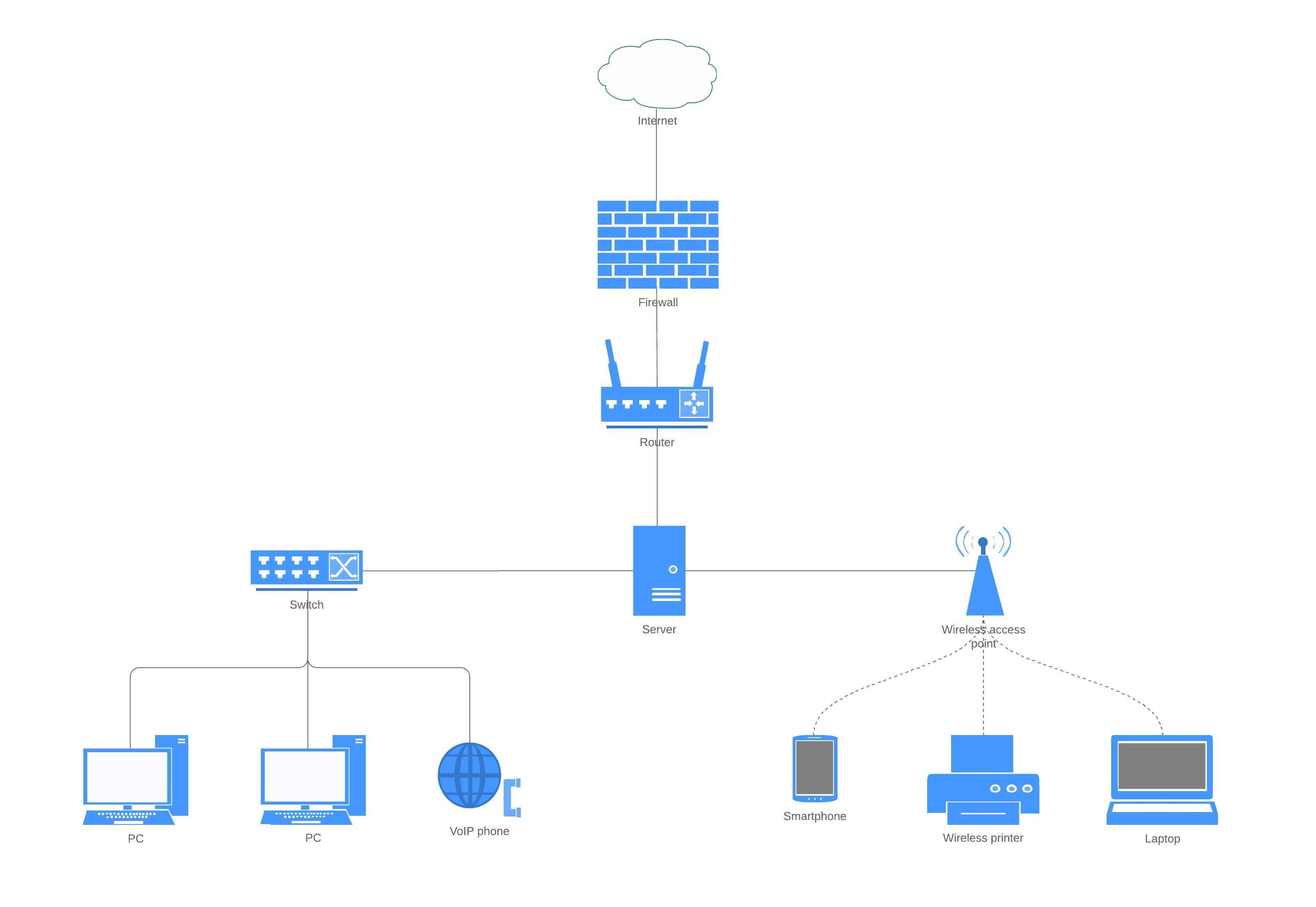
- Client – uses web browser to request pages from an internet server
- LAN – Local Area Network connects computers close to one another
- WAN – Wide Area Network connects two or more LANS together
- IXP – Internet Exchange Point to connect WANs together
- ISP – Internet Service Provider owns WANs and leases access to users
How an Internet Message is sent
- 1.Data being sent is divided into packets (Max size = 64K, 65535 bytes )
- 2.Packet has a header with some technical information and a FROM address, TO address and the actual data. Each header is 60 bytes
- 3.Packets divided in to multiple parts contain the order of the packet
- 4.Packets move on the Internet along different paths each taking different times
- 5.Packets are reordered
- 6.Received packets are acknowledged back to the sender
- 7.Sender resends packets that do not acknowledge